Wednesday, April 4, 2018

Looking for my writing? My most recent posts can be found here

Thursday, August 21, 2014

Week One (thirty-seven, or so, to go)

I wrote this last Friday, almost a week ago now.  I failed to post it because, well, this is Africa and the internet is not always guaranteed.  

I sat in the garden tonight, and watched the stars come out.

I suppose it was my celebration of sorts. For surviving the week. My first week as a Rosslyn teacher.

We talked about the intellectual virtues today,* and, for me, teaching has always been about courage. About doing hard things.

You see, I don't like talking in front of people. (My words, in air, disconnected from paper and pen, from keyboard and screen, jumble and squirm and become something utterly unmanageable. An approximation, an imprecision, and, at times, a wandering, gluttonous, slovenly mass, without meaning or sense.)

You see, I'm afraid of new people. (Not afraid of them, precisely, but afraid of being shown, in their presence, to be wanting. Uninteresting, blasé, with nothing particularly valuable to contribute or impart.)

You see, I'm a perfectionist who doesn't want to do it at all if I can't be guaranteed to do it right. (Doing things right is how I define my identity and my worth. That teaching can only ever be a process of approximation – of doing things better, of trying one's best – nearly destroys my sense of value and self.)

You see, I'm terrified of failing. (And failing, I'm afraid, is guaranteed. On at least one of the 180 days I teach, during at least one one of the 900 classes those days will contain, I will be sure to get it wrong. Probably more than once. Definitely more than once.)

I don't teach – have never taught – because I find it easy. I teach because, when I teach, I'm at my most vulnerable, my most broken, my most scared, my most challenged . . . and it's there, in that uncomfortable space, face to face with my failings, my short-comings, my desperate need for grace, that I am most capable of growth.

At least, that's why I think I teach. Why I think God keeps bringing it back into my life. Because teaching is not one of those things I can do on my own strength.

And so I'm forced to fall back on faith. Faith that God has brought me here. Faith that God brought me here because I can do this. Because I do have something to offer. Faith that God has worked through my teaching in the past, and can do it, will do it, again. Faith that, if I keep pressing into him, he will use me to be a blessing, in his way, in his time.

This week was hard. I was often conflicted; often disheartened; often discouraged; always exhausted. So many new faces and new names. And I miss the old faces. The old names. The old ways of doing things. The classes and students and colleagues I know. And, more to the point, the classes and students and colleagues who know (and value) me.

But I'm reminded by Parker Palmer that my desire to be known is the same desire shared by each and every one of my students. And I am not here to be known so much as to know. To know them. To see them. Their beauty, their potential, their fears and joys. Their passions. To call out of them that of God in them. To read meaning in the texts of their lives, and help them read that meaning too. In short, I'm here to love them. And that is more important, surely, than even teaching well.  

* "The development of God-honoring thinking habits that result from an earnest pursuit of truth" -- the intellectual virtues include Intellectual Courage, Intellectual Curiosity, Intellectual Humility, Intellectual Honesty, Intellectual Fair-Mindedness, Intellectual Tenacity, Intellectual Carefulness.  

Thursday, August 7, 2014

Twenty-Six Expressions of Thankfulness for a Year of Being Twenty-Six

I am 27 today, kicking off a new year, and a new adventure, here in Kenya.

I would love to have some words of wisdom to offer, ala my friend Koh, about moving into one's “late” twenties, and all that jazz, but all I really have is a list of things I'm thankful for from the spectacular year that was 26 (spectacular because, well, every year is spectacular, isn't it, if we really stop to notice?):

1. Joss Whedon's Much Ado About Nothing with the sibs, on (or about) my birthday.
2. A mini Tardis, which served as a good omen, linking my year of Doctor Who in the UK, with Karise, to my year of Doctor Who in Corvallis, with Marisa.
3. Blackberry walks.
4. Blueberry picking.
5.Trading a year of accomplishments in walking for a year of accomplishments in driving (the first time I was ever in a car alone was trying out my new commute from Corvallis to Newberg, and I made it =)).
6. A year of Corvallis to Newberg (and back) commuting. With the fields and the hills and the sky, alone with my thoughts and so many wondrous audiobooks.
7. The incredible opportunity of spending a year teaching at Fox. A bucket-list dream realized, and an experience that provided so many challenges and allowed room for so much growth.
8. Getting to co-teach with the spectacular Melanie Springer Mock.
9. Conversations with wise, wonderful people: Howard Macy, Rick Muthiah, Kathy Heininge, and Roget Newell, to name a few.
10. The protection of God and Mr. Toad during my scary car crash, in January.
11. Conversations and sleepovers and movies; Thai food and espresso; creating new memories, and celebrating the old; processing through who we are, and how we've changed, and what dreams still drive us -- all in the presence of the ever-fabulous Kohleun (once an FLP, always an FLP?).
12. My students, who challenged me in their writing, and in their discussions, and came to see me during office hours, and let me catch, even a glimpse, of the great beauty and light inside them. The many who met me halfway, and more than halfway, and blessed me with their friendship, their questions, and their gratitude.
13. A chance to read Faulkner and O'Connor in the company of Bill Jolliff and his wisdom and his class.
14. Theatre, even if only to watch, and not to participate: In the Family of Things, The House of Bernarda Alba, Parade, The Lion in Winter, and The Game's Afoot.
15. A year of reconnecting with dear friends (in Newberg, and in San Diego, and while roadtripping): Alicia, and Tammi, and Megan, and Michael, and Ruth, and Mariam, and Elspeth . . .
16. Time with family, at Thanksgiving (in Corvallis), and Christmas (in Bethlehem), and Brendan's graduation (New London and the Caribbean =)).
17. The World Cup, and all the joys of futbol.
18. Time (always too brief) with extended family. And what an incredible group of incredible people they are.
19. All the ways that God provided financially: Obamacare, and my job at Sunnyside, and parents and siblings who extended grace upon grace.
20. Being able to be a part of Susanna and Zack's wedding, and celebrate in the company of so many who dearly love them.
21. A friend who challenges me to write, and to seek God, and to serve others. Several days in her (and her grandparents') beautiful presence.
22. Books that gleam and spark: Art Objects
23. Films that do the same (inspiring conversation and thought): Noah
24. Others with whom to converse and think, and watch anime and Game of Thrones, and be challenged by to live the life one aspires to live.  
25. Three beautiful days in the beautiful UK, shared with such beautiful people.
26. The grace and patience of God, which undergirds all things: And all shall be well, and all shall be well, and all manner of things shall be well.

And one for the coming year:

27. That God has brought me to this place, to this garden, to these friends (both old and new), and leads me on; God's grace, and strength, sufficient for whatever lies ahead.  

Sunday, August 3, 2014

Orientating

This past week (my second in Kenya) has been dedicated to new staff orientation, which has included lectures about transition and TCKs, question and answer sessions about life in Kenya, and opportunities to grow to know our fellow incoming teachers.  Some of these opportunities have been officially organized (such as the Wednesday outing to a tea farm run by three generations of British immigrants) and others (no less significant) have come about less formally (such as the clinic run three of us made to get some new vaccinations -- in my case, typhoid, yellow fever, and hepatitis A & B).

[the tea farm]

During the course of all of this orientating, a comment was made about clashing cultural expectations, and the need to be aware that many students are coming from cultures with high uncertainty avoidance, and will find a classroom with open-ended questions and space for independent thinking and personal creativity deeply unsettling.  They want to be told exactly what the rules and expectations are, so they can be certain of doing the assignment correctly and giving the teacher exactly what he or she desires.

When it comes to teaching (and learning) I tend, like most Americans, to be pretty low on the uncertainty avoidance scale.  I like room to think for myself and define my own parameters, and I like for my students to do the same; I believe the process of taking ownership of one's own learning to be a significant, and life-giving skill.

Interestingly, however, when it comes to my walk of faith, I am pretty entrenched in the high uncertainty avoidance camp.  I want to be told, not what the rules are, per se, but exactly what is expected of me, and what structure I should exist within.  Where is the path, what is the path, and am I on the path?  I want to know, beyond a shadow of a doubt, that I am getting it right -- doing this "life" thing in the exact way that God desires.

I will do anything, or go anywhere, I am just desperate for God to make clear what that thing, or where that place, might be.

In other words, I am an eager-to-please, perfection-seeking student, terrified of the blank page and the open-ended assignment.  And God, perhaps, is wishing that I lived just a little more like I learn.   

Friday, August 1, 2014

Welcome to Africa

Hm . . . so, I seem to have been locked out of my most recent blog.  Until I get that situation rectified, I'm going to go ahead and post this (written last week) on here.  My first post in . . . well, a long time. 


It's day five of my new, African, adventure.

My last few months/weeks in the States (if one can discount the packing) were pretty glorious. Attending my “little” brother's graduation from the Coast Guard Academy, going on a Caribbean cruise with the family, seeing wonderful cousins and uncles and aunts in Minnesota, spending some time on the Oregon Coast, watching the World Cup, attending a dear friend's wedding in New Mexico, and getting to spend time with special people all along the way.

As a last hoorah of our year of living together, my amazing brother and sister-in-law took me into Portland the night before I flew out. We ate delicious Thai food, swam in our hotel pool, and got up super early to make my flight out of PDX. And if that wasn't enough, they sent me off with a packet of goodies ranging from tealight candles to pictures to snacks (not to mention some utterly epic princess band-aids).

[At PDX with my travel buddy and my bag of goodies]

So off I sailed from old things to new things, feeling very loved.

My next stop was three days in the UK – a wonderful transition, both in terms of jet-lag and the extra time to catch my breath, but also as an opportunity to reconnect with some beloved people and places before undertaking the process of connecting to all things new.


And then I arrived in Africa, on the night of the 21st, only to be met by a herd of zebra crossing the road. My drivers laughed and shrugged: “Welcome to Africa.”

Or, as one of my friends pointed out, “welcome back to Africa,” for this is the continent of my childhood, and even though the expanse of the Sahara separates the now from then, there are plants and trees I recognize, though it is all so much more here.

I'm living in a small apartment (a bedroom, a toilet and shower, a living space with a kitchen) on a compound that is very much a slice of Eden. So many colors, so much growth and life outside my windows. And my own private corner in which to drink coffee, read my Bible, and watch the birds.


My landlady is Swiss, and grows vegetables as well as flowers, telling me I can feel free to pick what I would like (herbs, and spinach, and white radish, and so much more), saying that she always offers the invitation, but no one ever takes her up on it (the implication seeming to be that young people these days prefer fast food to fresh greens) – I assured her that there is nothing I love so much as vegetables and fruit, and I have already helped myself to some of her basil and chives.

So if nothing else, I think I will love living here, in my own space, with a garden, and an awesome next door neighbor who took me hiking on Thursday to Mt. Longonot, where we walked the ridge of the volcano and I drank my first Stony and saw my first (non-zoo enclosed) giraffe. It was a glorious day.


[Can you spot the giraffe?]


And yesterday I had an adventure of a slightly different caliber, walking to the store on my own for the first time. I think I am slowly gaining my bearings, and discovering that yes, indeed, I can live here.

Though, please, don't ask me to drive.

Sunday, June 5, 2011

Time Displacement Activities (as Kim would say)

Well, you may be thinking that I've fallen off the face of the earth.  And I guess I kind of have.  Or, to be more accurate, the earth (in the guise of a dissertation due in 19 days) may have opened up to swallow me whole.  I do plan on eventually getting around to posting about some pre-term activities, like May Day and the Royal Wedding (which I attended =), but until the world stops turning dangerously quickly, here's a brief update on things I've been doing while I should have been locked away in the library, oblivious to a world beyond my windows:

Sitting next to Christine Baranski at the Perch (you know, that actress from Mamma Mia and The Big Bang Theory?), helping Kim celebrate completing her finals (I don't know if I can stress how big of a deal finals are here -- rather than marking the end of a semester's work, they, and they alone, are the assessing rod for one's entire Oxford degree -- think N.E.W.T.S. in Harry Potter), attending a celebratory birthday BBQ at the Kilns (C.S. Lewis's house) for Jonathan, my Jr. Dean (and Classics tutor) from my SCIO semester, going to a Low concert in London with a friend, and watching (rather than participating in) Summer VIIIs, the summer crew races (I haven't actually been rowing this term, which has probably been a good thing, but wasn't completely voluntary -- we ended up having too many women for the team, and while I would like to blame losing my seat on the fact that I was quite sick during trial week, and couldn't even complete the sprint length, much less make the time cut, the reality is that I'm not much of a speed demon anyway, so might have lost my place regardless -- a bummer, but not something I really have time to mope about).

Here are some pictures from my exciting life (that I should not be living):

 Friends waiting for Kim to exit her last exam. 

Kim emerging from the Exam Schools. 

Flowers and champagne.

What says victory better than a purple balloon?  

Flatmates.  =)

The Kilns.

Eating ice-cream while watching the division one races.

Sunday, May 1, 2011

Trinity Eights: a new boat for a new term

Well, our new Regent's boat has had its maiden voyage (for all I know, it's had a few of them - but this afternoon was the first women's crew outing).  I have christened it with my blood (stupid fingers always getting between the boat and my blade) and my sweat (yes, it was actually warm rowing today).

I've also caught my first crab.  Not exciting news.  Although, it's pretty crazy how quickly your body adapts to Matrix-like agility when threat of decapitation is imposed.  I've never thought of myself as someone with particularly quick reflexes, but insert a massively long blade coming towards me with intimidating power (and speed) and before I know it I've managed to bend my body over backwards and emerge intact.  The blade didn't even hit me.

All in all, a good outing.  We've been off the water for two months (and some, rejoining from Michaelmas term, for more like five), yet hit the ground running (metaphorically speaking) - rowing all eights, and not doing too shabby.  

Best of all, however, the new boat is ten kilos per boy (yes, it is a boys' boat) lighter than the last one.  This means that hoisting it out of the boat house and onto the water may no longer make me want to cry. 

Saturday, April 23, 2011

Communion: Words for Good Friday

I wrote this collection (would it be called a collection?) of reflections last summer in response to a prompt on communion.  I was reading Williams at the time [Shadows of Ecstasy] and (as tends to happen when reading Williams) my writing seems to have been shrouded in obscurity and abstraction.  

But these pieces still burn bright for me, even if they're rather inexplicable to others.  I post them today in honor of Good Friday and a dying God.  

Under the Mercy (as my dear friend would say).   


______________________

candlelight flickers
through gentle darkness, warm
mystery embraced
awash in chanted scripture
echoing soft
harmonies fall
and rise back
into the death of god
and all else fades
but the common union
between man and god and god and man
bread and body, wine and blood
as symbols and sacraments blur
and all is one and in one
and every breath
is holiness
______________________________

That which is, becoming that which it is not.  The mundane becoming sacred.  Barriers breached.  Between man and God.  The physical and the eternal.  Not union – the blurring of all into one, the destruction of difference, the swallowing up of self – but communion, the joining of that which is disparate, of symbol and reality, mystery and clarity, temporal and divine.  “Neither is this Thou, yet this also is Thou.”  Lewis states that, other than our neighbour, it is the holiest reality we will ever experience.  Yet it is holy in exactly the same way that our neighbour is holy.  The mystery of fellowship.  Of joining.  Of being one, and not one.  It is humanity taken into God, for it is a taste of the Trinity, and the sacred mystery that undergirds existence – the One that is Three.  It is real when the priest transmutes the elements into body and blood and the incarnation takes on flesh once more – expressing the lengths that Christ will travel for his beloved.  It is real when the Protestant partakes of the symbol – grape juice and saltine – and the spirit is set free to worship God in truth, deep calling out to deep.  And it is real when the Quaker rejects shadows and shells, attesting to the fullness of that which is, was, and will be – the sacred humanity of her neighbour and the God who dwells among them.  And when we are ready, it is real in the strange bright mystery of co-inherence – the bound togetherness of all things. 
______________________________

I read a book recently, in which there is a scene.  A scene in which seven siblings, standing beneath a sacred tree, link hands to pit the fullness of their spirit—their united selves—against the evil which threatens them.  There are sacred rituals that take place, sacred symbols that are exchanged, but the reality behind the sacrament’s shadows is the reality of seven hearts that beat as one.  Seven spirits who would each, unhesitatingly, exchange themselves for the other.  Seven children who feel the pain of the other as their own. 

The great horror of this story, the great and unabidable hurt, is that this circle is broken.  Evil wreaks its havoc, and the siblings lose themselves within their own isolated battles for courage and hope.  The generations turn, but nothing is ever the same.  The wholeness that was is no more. 

And I think it was this loss that broke me.  This loss that made me weep long into the night of the book’s ending.  For I had tasted—I had touched—the world as it should be, and it had been torn asunder by forces of decay.

Is it sacrilege to say that this is what Christ came to restore?  This unity of heart and mind.  This sacred circle of brothers and sister, bound by name, and blood, and every feeling of the heart.  This communion of the saints.    

Friday, April 22, 2011

my life in the sun

These last few days (and weeks) have been glorious in Oxford.  Sunshine and warmth and blossoms that fill the air with perfume and color.  I guess I've never really understood about the spring before - about why it's the season for twitterpation and first kisses.  But with a sky so blue and colors so bright it's impossible to feel anything but beautiful.  

That is, unless you're spending the day studying in the library.  Which I was - for a while.  So, in order to cope, I created a new routine: get up (with the assistance of three alarms), spend an hour saturating in the sun while eating a croissant and sipping coffee at Combibos (my new favorite coffee shop), make it to the library around the time they were opening their doors, write, saturate in the sun over a picnic lunch in the Botanic Garden, return to the library, write . . . you get the picture.   

my morning routine

lunch in the Botanic Garden across from Magdalen College

Eventually, however, I gave up on the library all together.  It wasn't helping my panic attacks, so now I just study in the parks . . . permanently.  Usually writing by hand, and then returning to my room to type up the notes at night.  But today I actually took my computer with me.

iced vanilla lattes help the writing process immensely 

the University Parks
So no, it's probably not the most efficient study plan.  And yes, the writing is going terribly slow.  But at least I'm happy while I'm doing it.  'Cause like I said, it's impossible not to feel pretty - at home with earth and sky, content, delighted, capable of flight - in the springtime.

Thursday, April 14, 2011

Oxford Writing

This is a picture of me writing my first ever Oxford essay, back in 2008.  It still pretty much sums up exactly how I feel about the writing experience.


On that note, off I go to get some more writing done. 

Wednesday, April 13, 2011

Traveling by Train

There is a strange exhilaration in train travel. Standing on an open-air platform, under a white-cloud speckled sky, waiting for a metal monster of motion and noise to come hurtling, rumbling, trudging down rusted tracks.

There is magic in moving across country, over rivers, beside fields of flowering yellow, with no roads or cars in sight.  Just spacious glass-filled images of running horses, rugged keeps, and ancient trees.

In Scotland, rumbling down to the border city of Carlisle, we passed a train, all clashing purples and bright reds, barreling in solitude through empty fields, and I couldn't help but wave hello to the Hogwarts Express.

Monday, April 4, 2011

Holiday on the Island

I am back at Oxford, after ten days of being filled with coach travel, Scottish treats, ocean views, and the laughter of friends.

I'm hoping that all of this fullness will spill over from my spirit into my writing, and that I'm ready to hunker down to four weeks of academic rigor as I prepare my option and theory essay for submission, and an outline of my dissertation for presentation to my adviser.

But that's tomorrow's worry.

Today I am full of migraine medication, sleep, espresso, an almond croissant, and bright memories.

Amberle, one of my good friends from undergrad (though how exactly we became friends is a bit of a mystery), flew in the Wednesday before last, the day after I sent off a rough draft of my theory essay to my supervisor.

I went to Heathrow to meet her, brought her back to Oxford, and then proceeded to drag her on a several mile walk through the city, and out to a country pub that (rumor has it) Lewis used to love.


We were attacked by a goose on the way.

Day two involved a visit to the Bodleian, and a very long walk around Magdalen's dear park, into the fellows' garden, pictures on their bridge, and more attacks by rabid killer geese, who flew at us, proceeded to follow our every move, glared daggers, and only allowed us to pass if we hid behind groups of elderly women.

I know he looks innocent, but don't be fooled.
Such excitement.

We also ducked in to Univ (University College), where Lewis did his undergrad, to pay our respects to the Shelley memorial.

And, of course, we paid homage at the Eagle and Child, the Inklings' pub.

Day three was an early morning into London, a stop by Leicester Square to purchase theatre tickets, and a London Walks tour of Westminster Abbey and the changing of the guard.  A Pret lunch at St. Paul's (somewhat of a tradition at this point), a meander across the Millennium Bridge, and a tour of the Globe, as well as a rather exciting hunt for the location of Shakespeare's actual theatre.


They were rehearsing Twelfth Night while we were there, and I couldn't help thinking, That's my play, when I heard the monologues.

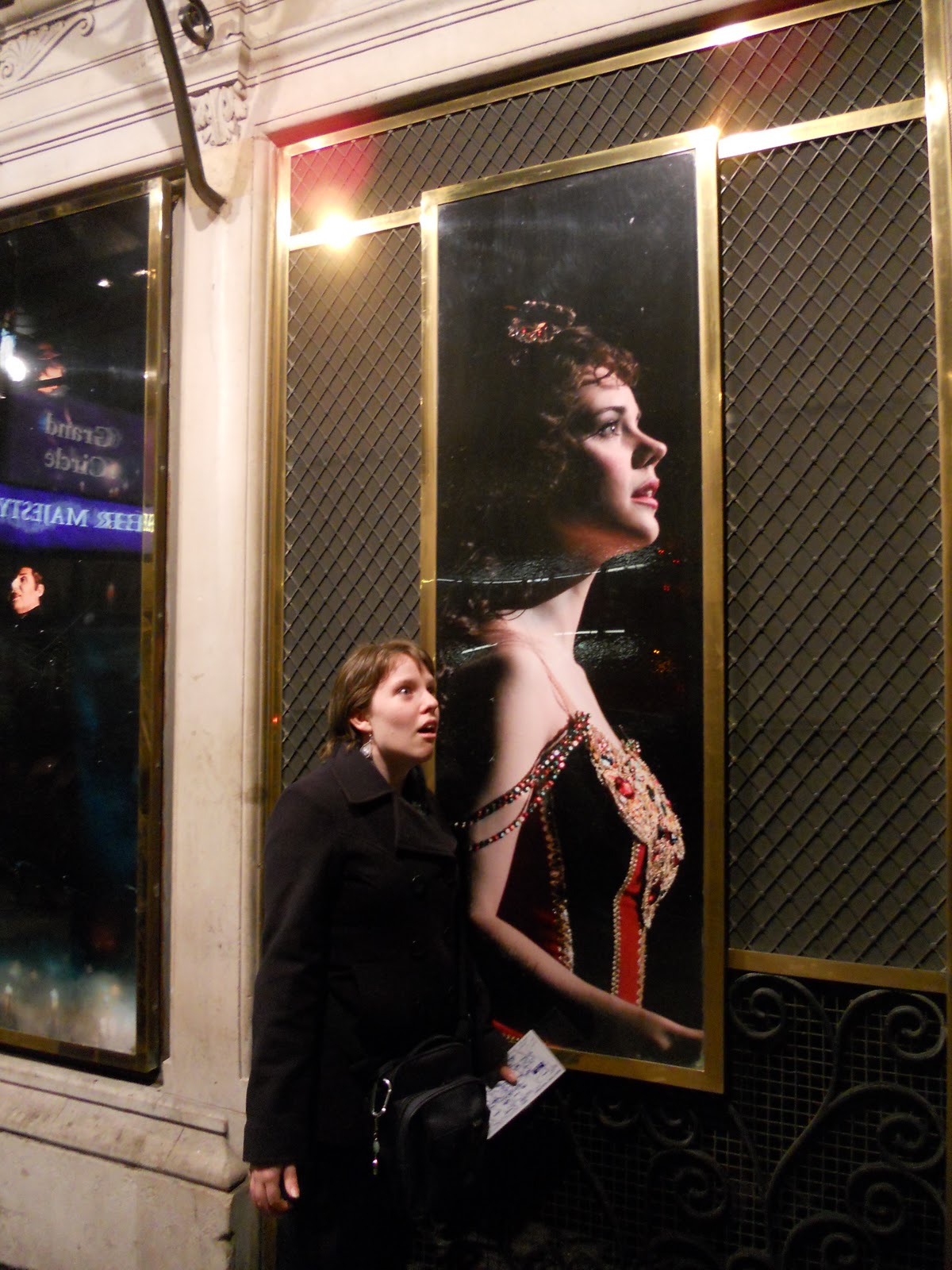
Dinner back in Leicester Sq., and then on to The Phantom of the Opera, my third time seeing it, but the first time in nearly eight years.  We were in the last row of the highest balcony, but the singing was wonderfully powerful, and the actress who played Christine gave a uniquely shattered performance – this was not an enamored singer, horrified by a view of ugliness (as Christine often seems to be played – the horror and resistance coming after the phantom's face is seen, not before), but a manipulated and vulnerable child, caught, from the beginning, in waking nightmares she can't escape.  The perfection usually required of Christine's voice gives her character a false sense of control, I think, but this Christine allowed her anguish to affect, and even distort, her music, so that, while she rose to tremendous heights (sometimes despite herself: sing my angel of music!), she also faltered and broke.


And hearing the music sung so well, I was reawakened to the reality that the movie, while a fun celebration of color and pageant, simply falls horribly short on vocals.

Back late, late, late to Oxford, and then packing, getting one hour of sleep, and returning to London to catch the coach to Scotland.

Visiting Kohleun in her beautiful house, with gardens and windows and flatmates with whom to drink coffee, and exploring St. Andrew's with tea crawls and trips to the sea.


Then, on Tuesday, a day in Edinburgh before heading to Cumbria for walks in the Lake District and time with the Doubs – dear friends from days in Egypt.


And I left my heart in a used bookstore where 80-year-old copies of Virginia Woolf's books dwell – but despite painfully cheap prices, there is no room in my suitcases to indulge my adoration.  But I did purchase a 100-year-old calf-skin bound copy of Milton's collected works, using my dissertation as an excuse.

Then back on a Megabus coach (crowded and stinking of urine) to trek down the country to London, and then home to Oxford.

And now I am alone again, with my books and my laptop, preparing to throw myself into research and writing, and wondering if the day will ever come when I have a home to fill with beautifully aged books, and long hours to write for joy and not for degrees, and days to see friends who do not live half a world away.  How I envy Wordsworth his sister and his Coleridge and his writing cottage in the Lake District, yet we must each live our own journeys, and mine, I am afraid, will always be torn between countries and continents and missing faces until the day when all things are made new, and wholeness swallows up the jagged separations.

Until that day I must, with the king and queen of Perelandra, bid my farewells until we pass out of the dimensions of time, and wish the splendour, the love, and the strength upon us all.

Tuesday, March 22, 2011

shifting seasons under an ever-moving sky

I've always been surprised at the frequency with which one seems to get asked about one's favorite season.  Personally, I've never really had an answer.  I mean, how does one differentiate between hot, hotter, and hottest?  Granted, I'm not being completely fair, but most of my life has measured seasonal change in temperature and little else.  Even in Oregon the seasons weren't particularly radical.  At least, not where I was walking through campus with my head stuck in a mountain of books.  Drizzly, rainy, sporadic sunshine.  Nothing too exciting.

But here, here I love to watch the seasons change.

Granted, most of winter wasn't particularly spectacular, though there is nothing much lovelier than snow falling in glowing lamplight.

But these days the world is awash with sprinkling petals -- consumed with flowering trees.

And in our college courtyard, I watch a tree, day by day, unfurl tiny, jewel-green leaves, sure I've never seen life bloom so gradually. 


But the autumn is definitely how I'll remember Oxford (due, in part, to the reality that it used to be the only way I remebered Oxford and will always be the way I saw it first).  The walls of ancient colleges ablaze with flaming vines.

As Virginia Woolf put it, "If the spirit of peace dwells anywhere, it is in the courts and quadrangles of Oxbridge on a fine October morning."


And over it all, a sky that changes day by day, hour by hour.  That glows in swimming blues, and yearns in charcoal grays.

To quote Woolf again (from Jacob's Room with some small alterations [and I'll reward anyone who spots them]):
They say the sky is the same everywhere. But above Oxford -- anyhow above the roof of Christ Church -- there is a difference. Is it fanciful to suppose the sky, washed into the crevices of Christ Church, lighter, thinner, more sparkling that the sky elsewhere? Does Oxford burn not only into the night, but into the day?
What did I do to deserve to live somewhere so spectacularly, hauntingly beautiful?

Oxford in Bloom

Spring, it would seem, is finally here.  Yesterday and today: actually WARM outside. 

Just ask Corinne.  


Friday, March 18, 2011

Cressida: "the nonsocial, nonpolitical, nonhuman half of the living structure" [Cixous]

Here's a reflection I wrote on the 2nd best play of the term, Troilus and Cressida.  Somehow I failed to post it (I really need to stop doing that).  
_________________________________

I went to watch Troilus and Cressida last night (Feb. 8th), with a group of friends from college.  It was a student production, playing at the same theatre where I watched The Last Five Years in the fall of 2008

And, once again, I left the theatre shaken. 

I had never watched, nor read, Troilus before, and so had no idea what to expect.  I knew it was, on some level, about two lovers in the midst of the Trojan war, but I didn’t know that it was also, much more forcefully, about the dissonance between the heroic world of warrior men, and the women’s realm they took for granted and violated without notice. 

Never having read the text, I’m unsure how much of the theme’s prominence was due to the original and how much to directorial choices, but either way it was a powerful (and sickening) depiction. 

From the beginning, women, clad in silk nightshifts (for the Greeks) and adapted Grecian togas (for the Trojans) set up the space – space that was then vacated of female presence (or, in the few cases that women remain on stage, active female presence).  Initially, I found the costume choices jarring, not least because of the dissonance between the semi-historical Trojan dresses, and the modern military attire of the men.  But as the play wore on, I came to appreciate that dissonance as a symbol of the utter separation of the two worlds.  As Kim (my  flatmate) pointed out during intermission, she disliked the costumes because they made the women vulnerable, and these “were not vulnerable women.”  But I think that was the point.  They make the women vulnerable despite themselves—barefoot in a world of boot-clad men—as the play goes on to graphically demonstrate that they are. 

But where I first truly grew uncomfortable (and began to sense the direction the play must be going) was in the “joyous” scene where Troilus and Cressida finally come together and swear their vows, and where Pandarus declares that if Troilus is true, let all faithful men be named Troilus, but if Cressida is false, let all faithless women be called Cressid.  She cannot be honored for a faithfulness that is expected of her, only dishonored by betrayal. 

And, of course, the injustice of this curse is staggering.  For women are not granted choices in a time of war.  They are treated as property, not beings with agency, yet they are still judged by adherence to ideals they have no choice in upholding (or violating). 

And so it is that Helen is talked about in all male-councils, bargained with as a possession that will increase or decrease male honor, and kept or given away on this basis alone. 

So it is that Cressida is traded to the Greeks, while Helen kept, because giving Helen back (despite general consensus that she is a whore without worth) would lessen Trojan honor, proving that they could not keep what they had stolen.  So Cressida is traded in order to return a captured Trojan (male) and uphold Trojan (male) promises. 

And Pandarus weeps, not for his niece given to the enemy, but for the boy who loves her, for this, he is sure, will destroy him.  It would be better, Pandarus declares, that Cressida had never been born than that this separation pain Troilus. 

And while Hector is welcomed into the Grecian camp as a brother in arms, worthy of honor despite the hundreds of deaths he has caused, Cressida, innocent of shedding a single Grecian’s blood, is met with sexual and physical assault. 

And, of course, Troilus sees her with Diomedes and judges her by standards of strength and choice she does not posses. 

Meanwhile, Andromache's pleas that Hector remain at home are received with the declaration that she is bringing him dishonor, for he has given his word that he will fight that day.  Never mind that Hector’s death, and Troy’s overthrow, will mean the enslavement of his prophetic wife and sister.  No, it is masculine honor at stake, not women’s freedom. 

And Achilles, who has promised his Trojan love that he will not fight, breaks his word to the woman in order to honor his love for his (male) companion, Patroclus. 

And the play ends with the Trojans singing, in the face of Hector’s death and Troy’s doom, of the honor for which they will be remembered.  And the women, weeping, sing with them – despite the knowledge that they have no part in the heroic deeds that will be passed down in memory, and will, instead, outlive their men to die in captivity and enslavement far away from home. 

And it makes me rage, because they simply don’t get it.  The men, with their honor and their male bonds and their realms of action and decision, do not understand the cost.  They break no promises, and are therefore innocent.  And, in their own way, so breathtakingly, fragily, beautiful.

The play itself was well acted, especially by Pandarus, Hector, and Thersites -- the wretched fool -- played by an actress with incredible physical control.  Cressida fidgeted too much, and though I understand the intention behind filling her with nervous energy, the movement was generated by the actress, not the character, and therefore distracted from the imagined reality, rather than adding to it.  Overall, Cressida, as a character, was not portrayed as overly sympathetic (this is not a girl I'd particularly want to know), but then I kind of think that's the point -- she doesn't deserve sympathy because we like her, she deserves it because she's just an ordinary human girl who's been wronged.  And thanks to some pretty impressive directing, the fight scenes, rather than being half-hearted and corny (as I feared they would be) were stylistic and interesting -- feeding the actors' energy and our own.    

Wednesday, March 16, 2011

"Medea I will become"

They huddled together, a mass of breathing, heaving, humanity: women, sibyls, witches, spirits, chorus, fates, woman.  Medea.

Medea unveiled.  De-masked.  Fractured, powerful, dangerous, vulnerable, mourning, mad, screaming, agonized, laughing, victorious, deadly.  Each of the actresses, both Medea and not Medea.  Medea as she becomes, Medea as she was, Medea as she is not.


By far the best play of term, it held us in its grasp for only fifty minutes.  A bare stage, a flurry of movement, a wailing, cacophony of voices.  It embodied the chaos of a conflicted soul, a woman torn between her choices.  This Medea was not guilty or innocent, evil or good, justifiable or monstrous, woman or demon, but all at once.  This Medea was the raging presence of all her sins and all her virtues -- her past guilt and long forgotten innocence.

It was a Kristevean revelry in the rage, rhythm, and passion of the chora, yet created from its chaos meaning that crystallized like diamond, digging deep.

And at its climax, splattered with the blood of a torn child, Medea stood, gloating in her furious, avenging glory, and crouched, shattered with grief, agonizingly gentle as she gathered the torn pieces of her once-breathing child. 

Here's a link to a brief clip from the play.

Tuesday, March 15, 2011

A Rowing Life

So, I never truly posted about rowing, so here's a taster from last fall, written by one of my teammates, the fabulous Corinne Smith: back it down, stern pair.  She's an English MSt student, the only other postgrad on the team, and I think she excellently captures the gist of the rowing experience.  If I had written it though, the title would be, "row it on, bow pair."

Our team has changed a bit since last term, as we lost several girls when the weather turned dreary (not that it wasn't dreary already), and our two captains now row with us (since, having rowed Christ Church, we're no longer a novice crew).  But the experience remains basically unchanged, the only real difference being that we now punctuate our midnight study sessions with erg training -- need to work on that stamina.   

And for the record, we did lose.  And lose.  And lose.  Good thing that I'm not in it for the racing.  Just the early morning training sessions.  =)

Oxford ghosts

Let me just preface this by saying that I don't write poetry.  But apparently walking home from the Bodleian in the dark does weird things to my psyche.  I jotted this down sometime in November. 
_________________________


Are there hauntings in these buildings?—
ancient effigies of stone—

where empty rooms
forgotten stairways
nooks and crannies unexplored
or turned
with whitewashed paint
to modern studies
where boys and girls
read ancient worlds
in artificial lamplight,
the warmth of dying coffee
in ceramic mugs
mismatched,
and fight to enter in
to empire
as shadows are dispersed
by rising sunlight on the river, tamed

until tomorrow

Friday, March 11, 2011

Oxford, London, Stratford: Theatre in 2008

So, I do realize that this post is more than two years too late.  But better late than never, right?  So here is a look at the shows I saw the last time I was in Oxford, partially recovered from an unpublished post, and partially written looking back from the present.  I have to say, I may have only been here for a semester, but I saw some fantastic theatre. 


I went to England about a week early, to have some time to hang out with Kohleun before school started. We spent some time in Scotland (in a B&B on the coast -- so beautiful), a couple of days in Carlisle with one of my best friends and her family, and then our last day in London. We walked around in Leicester Sq., ate lunch in front of St. Paul's (and waited for my migraine to go away), took a double-decker bus past parliament and Big Ben, visited the Tate Modern, took pictures in front of Shakespeare's Globe, and ate in a pub. Then we did what everyone must do when they visit London: we went to a show!
 
Specifically, we went to see Chicago. It seemed like an appropriate choice for a girls' night out, and all our other picks were a bit out of our price range. Although the storyline isn't my favorite, it had great dancing (better and more often than the film -- with the exception of Billy's role [after all, how can you beat Richard Gere tap dancing?]), and the woman who played Zelma was great. We also enjoyed Roxie's: "Think big Roxie! I'll have lots of boys!" (maybe it was one of those moments that you had to be there for . . . ).

Then, when Mommy came to visit, we went to see Wicked. I'd seen it once before, with a good friend in the States, but I really wanted to share it with her. It's a great show. Everything a musical should be. =)


Then, my amazingly talented older brother secured us seats to the sold-out production of Ivanov, with Kenneth Branagh! It was amazing. Definitely one of my life dreams fulfilled. I've wanted to see Branagh live since I first saw Much Ado About Nothing when I was nine.

That weekend, Jordan, Marisa, and I went to see Blood Brothers. Jordan and I had seen it before, in London during his senior year of high school, but it's one of our favorite shows, so we were really excited about seeing it again, and sharing it with Marisa. It's an incredible combination of music, story, and acting, and is known for reaping standing ovations -- every single night.

 
That next weekend my dad was in town, and we took a chance on a show neither of us had ever seen (or really heard about): The Lady in Black.  Turned out to be one of the most incredible pieces of acting (and remarkable shows) I've ever seen.  The crazy thing about the play is that it's meant to be scary . . . and it is.  I'm pretty sure I even remember people screaming.  Yet there are only two actors and a few boxes on stage.  Everything else (other than a few well-placed light and sound ques) is pretty much in your head.  An incredible exploration of the limits (or non-limits) of the medium.  Yes, you're constantly pulled back to the realization that you're sitting in a theatre seat, watching an empty stage with a room full of other people, but the remarkable thing is that there are moments in which you forget.

I saw The Last Five Years (which I've written about elsewhere) in Oxford with some friends, and Zorro by myself in London to celebrate my first completed tutorial.

And then there was Stratford.

 
During the first few weeks of our program, a visiting lecturer talked to us about Shakespeare.  An expert in her field, who had talked and laughed with the likes of Sir Ian McKellen, she informed us that Shakespearean history was being made at that very moment: the Hamlet of our generation was being performed in Stratford-upon-Avon.  She said it was the performance future students of Shakespeare (actors and academics alike) would study, and that whether we had to beg, borrow, or steal, we had to get ourselves there.
 
Easier said than done.  
 
Needless to say, it had been sold out for months, and without my brother's awesome eBay skills we were stranded . . . almost.  Luckily for us, the RSC believes in student tickets, and they reserve ten, priced at five pounds each, that can only be bought on the day of the show.  So we did what any committed fans would do, we jumped on a bus down to Stratford, pretended to be hobos in the RSC courtyard, spent the night shivering in the rain, and secured our tickets bright and early the next morning.


It was incredible.  The show, and the experience.  There was a matinee of A Midsummer Night's Dream on the same day, so we went to that too (also for five pounds).  Never my favorite Shakespeare, it was nonetheless excellently executed, and since the RSC is an ensemble, it was fascinating to see the actors perform such different roles.

Hamlet itself was nothing to look at.  No spectacle (other than a cracking mirror), on a nearly empty stage.  Which simply highlighted the fact that the acting was phenomenal.  I have never been to a show (especially a Shakespeare) where there was so little confusion over language.  Every line was pristinely clear, and not because I'm overly familiar with Hamlet (I'm not), but because the actors connected every line so irrevocably to intention and thought.

And who were these actors?  Only the incredible Patrick Stuart and incomparable David Tennant (who, I have to admit, I had never heard of before the play, but I quickly learned to laud his wonders, and will be seeing him in Much Ado About Nothing this summer with the fantastic Sara Kelm).

All-in-all, nine shows in fourteen weeks -- not bad for a semester in which I also wrote over 34,000 words and read who knows how many pages of Greek tragedies, modernist novels, and secondary criticism.  It makes my current achievements look rather half-hearted.