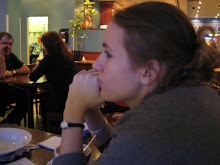
Kohleun just introduced me to the song "I am not my hair" by India.Arie, the themes of which are close to my heart. It may seem like an obvious message, yet there are moments when I feel like the whole crazy world just doesn't get it -- and that it's the most important message we can hear.
It's not just about hair, obviously, but all of the ways in which we're required to live up to expectations and imagined reality. All the ways we're required to hide our true humanity.
I wrote "Bare" for a creative writing class a few years ago. It was a semester of intense angst centered around this subject, and I almost shaved my head over Christmas just to prove a point.
Some people have been offended by this piece, but please don't be. It's not meant to be taken analytically, as an absolute profession of belief, but as an experimental attempt to capture something that I've experienced. And that I long for. As I've said elsewhere, "I think, through this, I was trying to touch on the issue of pain . . . devastation . . . war . . . and the way our society hides from those things. From the reality of sweat and blood, behind the facade of perfection. I believe in beauty, but it is a very different type of beauty than the ideal my culture is trying to force down my throat. It is a beauty that comes through the ashes—the marks of living—rather than by denying them."
Bare—An Ode to Beauty Bald
I want to shave my head. It’s one of those crazy ideas that terrify my parents. They interpret it, I think, as a sign of my slowly dissolving faculties. The warping of my brain by too much study and feminist theology. After all, why would anyone want to destroy all sign of womanly beauty? The golden ringlets that grew into longer curls. Shear them off in humiliation and shame.
I try to explain. How a boy I liked, once told me that he liked my hair. Liked it down. Said it made me beautiful, those strands of tarnished gold. Strands that are not me.
And I rebel. I will not be my hair. I will reclaim my womanhood from a Bible that proclaims me, and my head, to be man’s glory.
I want to be known for the mind that lies beneath the hair. For the part of me that thinks and yearns and ponders. For the passion and the life, under the meaningless wisps that grow and die, without my consent or say-so. That require nothing of me. Reflect nothing on me.
I want to shave my head in honor of those who never had the choice. In solidarity with the broken. The women at Bergen-Belsen and Dachau. Auschwitz and Buchenwald. Those who survived, and those who didn’t. To honor a humanity that was not taken, cannot be taken, with our hair.
To celebrate survival. From cancer. Leukemia. Radiation and chemo. The women who wear headscarves, and wigs. Afraid to show the scars of battle. The sign of loss, and life. Proof that they’re still here.
I want to join the ranks of men like Yule Brynner and Michael Jordan. Of human beauty unadorned. Skin, and sweat, and age. Unafraid to expose the blue veins that pump life, blood and oxygen, through membrane and golden tissue. The sandpaper texture. The shape of their skulls.
I want to demonstrate a different kind of beauty. Sleek and sexy elegance that denies hairspray and color dyes, styling products and curling irons. Proclaim freedom from magazine images and picturesque perfection. From Barbie dolls and Disney princesses, long silken tendrils, hair to their knees. Coiffured and flowing expectations. Stop hiding beneath the mask of color.
I want to wear henna on my head. Make patterns of tribal beauty. Declare myself at home with earth and sky.
I want to stop running from the feel of my own skin. I want to be myself, free of pins and clips and rubber-bands. And I want to love it.
I want to inhale wind and rain through the pores on my skull. To taste life and pain. To deny the acceptability of pretence, to destroy the masquerade, the papier-mâchéd perfection. To mourn injustice with the women of Beowulf—heads bare, weeping to high heaven. Sackcloth and ashes, and shorn hair.
And most of all, I want to be a nun. Set apart for unreserved worship. To return to child-like innocence, and feel nothing between my head and God, but air and sunlight. To be uncovered before my maker, not in shame, but in the humility of a newborn, and beloved, child. To remember my humanity in the presence of a genderless God. A God who created my soul before she created my hair.
I want to feel my prayers rise out of the top of my skull. Float along air currents. Be breathed in by the Almighty (hairless) God.
"And I began to see things in a way that let me hold the world without me in it."
I'm sitting in the Hong Kong airport, waiting for my flight to Jordan, having just flown from Korea on a very nice Cathay Pacific flight. With an individual screen, and lots of film choices, but only time for one movie, I decided to go with Peter Jackson's The Lovely Bones. And I was favorably impressed.
It seems odd to describe a movie about murder as beautiful, but I'm loath to describe it as anything else. Peter Jackson has created a haunting paradox -- a movie about death (and not the peaceful, innoncent kind) that is nothing less than a celebration of life. There are dark moments in the film, to be sure, but the overarching impression is one of light and love. The picture I'll carry with me is of a laughing family, with deep roots and strong ties, fierce in their love and strong in their courage -- the kind of family I want to have.
In the end, I think Jackson is able to take a horrific sort of death (the kind that has haunted my nightmares since childhood) and show that really, in all the ways that matter, Suzie dies the best sort of death (if any death can be good), because she has never spent a moment surrounded by anything but love. As someone states in a different movie I watched recently, "Our finger prints don't fade within the lives they touch." In other words, the Salmons are no less a family after Suzie's death than they were before it. Her place is permanent, and (to quote e.e. cummings) they carry her heart with them.
On a side note, the storytelling perspective is interesting in that it's narrated by Suzie after her death. One of the reasons I was interested in watching it in the first place was that I'd read a review of the book which described it as a 'post-death coming of age story'. Suzie is in every way the protagonist -- a protagonist who must deal with the ending of her idealic childhood, though the cause, in this case, is not growing up but murder. A protagonist who must learn, as we all must, how to hold on to everything that matters (like family and love) while coming to grips with the inevitable changes in herself and the world around her.
And as a final note, I may have watched the film on a bad quality airplane screen, but even so, some of the scenes are absolutely gorgeous.
2. The Gunsan lake, with its bridge of lights and happiness (with special orbs to promote love and dreaming).
3. The shoes. Definitely the brightest, craziest sneakers I've ever seen (think fluorescent yellow, shiny, and huge). But they also love their high heels, which are tall, and not at all the standardized American variety.
4. The red roses that spill over every fence.
5. The uniquely poetic way of using English: "provincial tangible cultural asset."
6. Chicken on a stick with amazing barbeque sauce. Street food at its finest.
7. The "couple sets" -- i.e. his and her matching clothing, drinking straws (because drinks are meant to be shared, not experienced alone), chopsticks, watches, and just about everything else you can think of.
8. Jordan and Marisa's bunny, Faraday, who is very inquisitive, and seems to think Brendan and Thani are boy bunnies.
9. Korean pizza -- some of the yummiest I've ever eaten, with sweet potato crust.
10. Green tea popsicles.
11. Shaved ice desserts, with ice cream, whipped cream, strawberries, shaved ice, cornflakes and fruitloops. Odd sounding, delicious tasting. As an added bonus, you get to eat them while swinging in rocking chairs.
12. Strangers who invite you to share in their picnics, and offer you food at the side of the road.
13. Open rooms with wood floors in which to take naps.
14. Traditional teahouses, with inner courtyards and low tables, even if they do charge too much for tea. =)
15. Biking around islands where seafood is eaten raw or dried on clotheslines in the sun.
16. The culture of open spaces, bare feet and ground sitting, where pouring water requires respect, and giving and receiving is a ceremony of significance.
17. And, of course, the very best part: seeing family. =)
I'm sitting in my almost empty classroom on the last day of finals, and it is a very strange feeling.
I didn't expect to be sad when this year ended.
Halfway through the first semester, I was almost convinced I wanted to come back next year. Come back and do it better. Come back and conquer the unconquerable quest for excellence.
But then it just became too much. Too stressful, too exhausting, too frustrating. Working with kids, when respect is the highest need on your list, is a very challenging endeavor. For one thing, it's not easy to gain their respect. For another, they're not very good at knowing how to respect, even when they want to.
So, in the midst of those spring blues, I decided that continuing on teaching was definitely NOT the path for me.
But now, in the midst of goodbyes, final evaluations, talks on the roof about books, class parties, and packing up my classroom (which I've lived in, much more than I've lived at home, these past several months), I'm not so sure.
I'm going to miss these students. Miss these conversations. Miss the crazy drama of my 9th grade class. Miss the wide-eyed expectation of my 7th graders. Miss the quiet kindness of my seniors. And, perhaps above all, miss the thrill of creation with my actors.
Several of my 9th graders stayed behind after their "final" (it was actually a class party mixed with performances of their original tragedies -- the actual test had been done early) to convince me of all the reasons I had to stay. These included (but were not limited to) having all my students dress up like Darth Vader, having Claire make me peach cobbler every day, having Yasmeen hook me up with a British husband (who can sing, is rich, and works for the U.N.), having Star Wars marathons at Matt's house, and being teased mercilessly about, well, just about everything.
[the wonderfully crazy 9th grade class]
It was a pretty tempting offer. And I want to come back. Want to teach these students again. Want to see them change and grow. Want to grow with them. I told them that maybe when they're seniors I'll come be their British literature teacher.
But who knows? Dreams are good, but in this transient world, and transient lifestyle, it's so hard to believe that it'll actually come back around.
And it saddens me, much more than I expected, because I believe that we could keep growing together. That we could trust each other more, respect each other more, learn together more. That we've built a foundation (with much toil and tears, at least on my part) and next year could be better.
There are so many things I want to experience and do. I only get to live once, and I want to make it count. Want to experience all I can. Orphanages and convents and farms and universities and protests. And yet, I also want to build. Want to have a foundation, and get to grow on it. Get to see something emerge. Get to lay deep roots. Get to be part of something permanent and stable. Get to invest. Beyond a year, beyond a class.
Here is some joy to share with you. This is a selection of some haiku my 7th graders wrote this year. One (by Anna-Lena) tied for 3rd place in the formal category of the poetry contest Whitman held (and there were 180 overall entries, 7th-12th grade, so placing was kind of a big deal =). And "Bob" and "Test Day" are probably two of my favorite funny poems ever.
Flashes of Lightning, Rolls of Thunder As the the thunder rolls and lightning flashes brightly I watch with wonder
by Anna-Lena
Test Day Is it Monday, Josh? No, it's Tuesday. The test day. Oops! I am busted.
Clouds It's cloudy outside Every test day, it's cloudy Like it was promised.
by Chan Young
Who left the milk out? Spoiled and rotten unhealthy and so chunky left out in the sun
by Josh
Bob Bob is a good friend But Bob stole my cookie jar Poor Bob is dead now
by Bassam and Elias
Traveling Clouds Carried by the wind Sending shade upon the land mixing with the blue
Lost Strength No water to drink, no sun to shine upon it. Once strong, it withers.
by Bridget (who wrote a poem that came in 1st place for the humorous category)
Insomnia Hearing thunder roar, Seeing lightning flash by me, Trying to fall asleep.
The Ugly Duckling Ducklings mocking him, the small duckling cries, he just swims away.
Somewhat inexplicably, I'm only nine days away from the end of my first year of teaching.
This is crazy to me. And very stressful. Who knew there could be so much left to do? So much to simply stay on top of -- not to mention those far-off, crazy dreams of actually finishing well.
Tomorrow I will listen to the last two novel presentations from my seniors, and do a very brief review in which I'll try to recap everything they've learned (or at least studied) this year. Then I'll give them their final on Wednesday, and they will be done. Out of here and on to bigger and better things (like traveling to Turkey for a week).
But it's my other classes that I'm more concerned about. The classes that have wormed their way into my heart and stuck themselves onto the walls of my life, with sticky glue and tenacity. The classes I'll carry with me when I leave.
It isn't that I don't love my seniors -- I do. It's just that they're already individuals, cutting their own paths in the world, without need for school or guidance. It's just that I'm too close to their age to really be a role model or someone to look up to. It's just that they already have one foot out the door, and it's hard to listen while their feet are itching to run.
My 9th graders, on the other hand, while they yell, and jump up from their seats, and hum songs, and speak without raising their hands, and tease me mercilessly, actually believe I have something to teach them. And they're willing and ready to learn. Eager to soak up anything that might fall into their paths. Eager to live and experience and grow.
Then there are my 7th graders. The class that is truly mine. My homeroom. My double-periods of English. Eight hours a week I spend with them, and they spend many more reading for me, writing for me, and learning vocab for me. I never expected to love teaching Middle School, yet somehow, with their energy, enthusiasm, laughter and hugs, they have become one of the bright spots in my day.
How do I say goodbye to these faces, these people? How does it just end one day, among diplomas and waving caps, and then, no more. They'll go on to read or not read, to care passionately or to sit apathetically, and I'll never know.
"You know it by the northern look of the shore, by the salt-worried faces, by an absence of trees, an abundance of lighthouses. It's a serious ocean."
Looking over some poetry papers I wrote in college (the aim being to help my students with the fine art of poetic analysis), I accidentally discovered Anne Stevenson's Scottish poems - poems with a "rare weather of aloneness . . . which conjure the landscape and climate of eastern Scotland with its chilly coast and chastened atmosphere" (Ray Parini).
"Fire struggles in the chimney like an animal. It's caught in a life, as when the tide pulls the Tay out scarring predictable mudscape— seawater's knifework notching quick runnel and channel.
That's how you remember the alternative lives. You saw them, could never have lived them. A ribbon of birds is pulled raggedly over November. You're pulled between now and the way you will not escape."
I discovered Sappho this week. And she, combined with teaching haikus to my 7th graders, may have changed my life.
I've never really been a huge fan of poetry, especially not the kind with awkward line breaks, overkill descriptions, and no narrative. Epic poetry I love. Smooth flowing poetry (like Boland's and Nye's) I can appreciate. But that's about as far as it goes.
This past week, however, I have been awed by the power of apples turning red, silver moons setting, and 5-syllable lines. The power of simple words, line breaks, and concrete images, to evoke emotion and meaning.
Although they are
Only breath, words Which I command are immortal.
-translated by Mary Bernard
Like a sweet apple turning red high on the tip of the topmost branch. Forgotten by pickers.
Was Julian of Norwich in any way representative of medieval women as a whole?
Does an understanding of Mary Wollstonecraft's life aid or hinder an appreciation of her works?
Was there a specifically feminine contribution to the corpus of war writing?
Discuss the representation of alienation, isolation and the feminist consciousness in Mrs Dalloway.
What, if anything, is going on in To the Lighthouse?
Discuss the issue of male and female perspectives as Virginia Woolf understands and portrays it in Orlando.
Discuss the significance of chaos and shape in The Waves.
Discuss the idea of established 'male' values vs. 'female' values in A Room of One's Own.
How do Woolf's writings (specifically Three Guineas) engage with politics and creativity?
To what extent does Virginia Woolf’s criticism develop and reflect a holistic theory of writing?
What revolutionary ‘position and outlook’ do you get in relation to Virginia Woolf’s situation in life as depicted in her biographies?
In the Iliad, what is the role of the gods?
In what ways are Oedipus Tyrannus and The Bacchae tragedies according to Aristotle's Poetics?
Is the Aeneid a straightforward eulogy of Rome and its empire, or does Virgil keep his poetic integrity?
Discuss the “life of love” created by Catullus, Horace and Propertius.
In what ways does, or should, an understanding of historical context affect our interpretation of Euripides’ Medea as a positive or negative portrayal of women?


 1. The country slogan: Korea Sparkling.


 [the wonderfully crazy 9th grade class]